Surface aerosol sprays purchased in retail aisles consistently trigger colony budding in Middle Georgia homes, causing a single Argentine or odorous house ant supercolony to fracture into 3 to 5 distinct satellite…
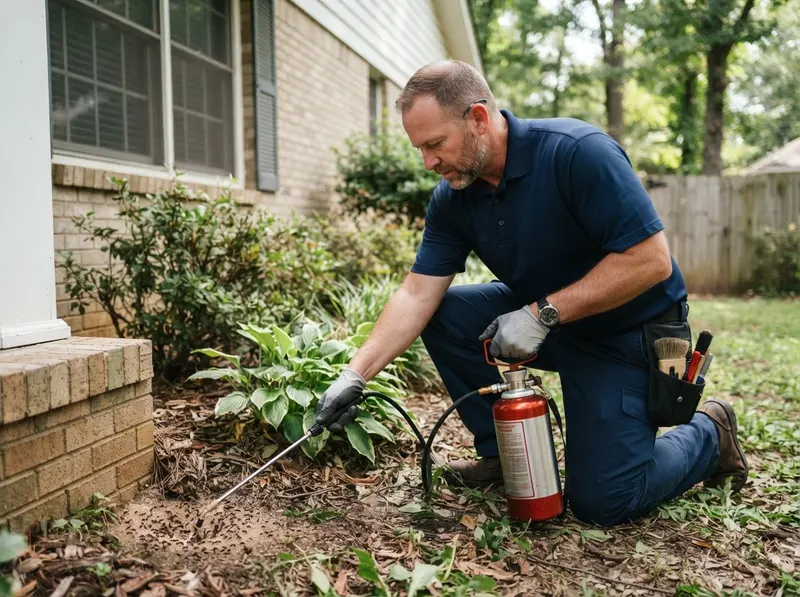
Surface aerosol sprays purchased in retail aisles consistently trigger colony budding in Middle Georgia homes, causing a single Argentine or odorous house ant supercolony to fracture into 3 to 5 distinct satellite nests within wall voids. In Macon neighborhoods like Shirley Hills and Ingleside, mature oak canopies deposit organic debris that retains moisture against exterior brick veneer and mortar joints. When worker ants locate these damp entry corridors near subfloors, perimeter barrier integrity collapses. ShieldPoint Pest Control resolves chronic trailing by utilizing slow-acting, non-repellent transfer chemistry. Foraging workers cross micro-dosed perimeter zones, absorb the material without immediate mortality, and groom the active toxicant directly into the queen's chamber beneath the crawlspace foundation.
Structural design across Bibb County dictates specific application vectors. Historic raised piers in the Vineville Historic District and Intown Historic District allow humid air to settle over dense red clay soil, creating ideal thermal nesting chambers for carpenter ants that bore nesting galleries into damp floor joists. Conversely, slab-on-grade tract builds in Suburban Woods and Northwoods funnel acrobat and pavement ant trails through expansion joints and plumbing penetrations beneath concrete pads. Addressing these entry points requires an engineering-focused perimeter exclusion model: boring precise access ports into infested void cavities, applying targeted moisture barriers, and establishing a 3-foot vertical and 10-foot horizontal exterior defensive apron.
Deciding between perimeter barrier maintenance and full structural colony elimination depends on nest localization. If ant sightings remain isolated to an outdoor patio near Lake Tobesofkee, localized non-invasive baiting suffices without chemical applications indoors. However, when foraging lines appear across interior kitchen counters, along baseboards in Cherokee Heights, or near plumbing stacks in East Macon, the reproductive nest resides inside the subfloor perimeter. In this scenario, structural colony elimination is required. The trade-off involves allowing active trails to persist for 72 to 96 hours post-application so workers successfully transport the bait matrix to the queen, rather than experiencing the immediate cosmetic knockdown of repelling contact sprays that leave the egg-laying core viable.
Every job gets a firm, written price after a free on-site visit.
Tell us about your ant colony elimination job in Macon and we'll send a clear, written quote, usually the same day.
 ShieldPoint Pest Control